

Data Integration in 2026: Eliminating Silos with Smart Connectors
Introduction In 2026, data is everywhere. It flows through CRMs, ERPs, marketing platforms, IoT devices, finance tools, and AI systems. Yet many companies still struggle with ...

Introduction
In 2026, data is everywhere. It flows through CRMs, ERPs, marketing platforms, IoT devices, finance tools, and AI systems. Yet many companies still struggle with the same old problem – their data lives in silos.
Different departments use different tools. Systems do not talk to each other. As a result, decisions are slower, insights are incomplete, and automation becomes difficult.
This is where modern data integration and smart connectors come in. They are becoming a key enabler for digital transformation.
Let’s explore what data integration in 2026 looks like, how smart connectors work, and how companies can use them to finally eliminate silos.
What Is Data Integration Today?
Data integration is the process of connecting multiple data sources into a unified, consistent view. The goal is simple:
- Share data across systems
- Reduce manual data handling
- Improve data quality and consistency
- Enable real-time analytics and automation
In the past, integration was often built with custom scripts and point-to-point connections. These were fragile and hard to scale. In 2026, the approach is different.
Modern integration is:
- API-driven
- Event-based
- Cloud-native
- Highly automated
- Designed for real-time or near-real-time use
And at the center of this shift are smart connectors.
What Are Smart Connectors?
Smart connectors are pre-built or configurable integration components that connect systems, platforms, and data sources with minimal custom development. They do more than just move data.
Smart connectors can:
- Transform data formats
- Validate data quality
- Handle errors automatically
- Sync data in real time
- Apply business rules during data transfer
- Monitor performance and failures
In short, they make integration faster, safer, and more scalable.
Instead of building and maintaining dozens of custom integrations, companies can use connectors that adapt to different systems and evolve with them.

Why Data Silos Still Exist
Despite modern tools, silos remain common. The reasons are often organizational and technical:
- Departments choose tools independently
- Legacy systems are hard to replace
- Mergers and acquisitions add complexity
- Different data standards are used
- Integration is treated as an afterthought
This leads to duplicated data, inconsistent reports, and fragmented customer experiences. Smart integration addresses these problems directly.
Key Trends in Data Integration for 2026
Here are the most important trends shaping data integration this year.
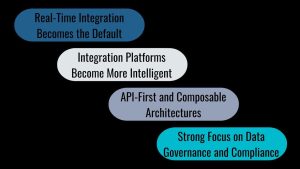
1. Real-Time Integration Becomes the Default
Batch updates are no longer enough. Businesses need fresh data for:
- Customer personalization
- Fraud detection
- Inventory optimization
- Predictive maintenance
- Dynamic pricing
Smart connectors support event-driven architectures and streaming pipelines. This allows data to move as soon as it changes.
2. Integration Platforms Become More Intelligent
Integration tools now include AI features:
- Automatic schema mapping
- Smart data matching and deduplication
- Anomaly detection in data flows
- Self-healing pipelines that retry or reroute on failure
This reduces operational effort and improves reliability.
3. API-First and Composable Architectures
Modern systems expose clean APIs. Smart connectors use these APIs to create modular, reusable integrations.
This supports:
- Faster system changes
- Easier vendor replacement
- Lower integration risk
Integration becomes part of the product architecture, not just an IT task.
4. Strong Focus on Data Governance and Compliance
With stricter regulations and growing security concerns, integration must be compliant by design.
Smart connectors now include:
- Encryption and secure authentication
- Audit logs
- Data lineage tracking
- Role-based access control
This is essential for industries like healthcare, finance, and enterprise SaaS.
Business Benefits of Smart Data Integration
Eliminating silos delivers clear business value.
- Better Decision Making. Leaders see one consistent version of the truth. Reports are reliable. Forecasts improve.
- Higher Operational Efficiency. Manual data handling is reduced. Errors drop. Processes become automated.
- Improved Customer Experience. Customer data is unified across touchpoints. Personalization becomes easier and more accurate.
- Faster Innovation. New tools can be connected quickly. Experiments are cheaper. Time-to-market improves.
Practical Use Cases
Here are a few real-world examples of smart integration in action:
- E-commerce: Syncing orders, inventory, payments, and customer profiles across platforms in real time.
- Logistics: Connecting IoT tracking data with ERP and analytics systems.
- Healthcare: Integrating patient records, lab systems, and billing platforms securely.
- SaaS: Unifying product usage data, CRM, and marketing automation for growth insights.

How InStandart Helps
At InStandart, we help companies design and implement scalable, secure, and future-ready integration architectures.
Our approach includes:
- Assessing existing systems and data flows
- Identifying integration gaps and risks
- Selecting or building the right smart connectors
- Designing event-driven and API-based integration layers
- Ensuring data quality, governance, and compliance
- Supporting long-term scalability and maintenance
We do not just connect systems. We help build a unified data foundation for growth.
Conclusion
In 2026, data integration is no longer optional. It is a core capability. Smart connectors allow companies to move beyond fragile, manual integrations and build connected, intelligent digital ecosystems.
By eliminating silos, organizations unlock better insights, faster operations, and stronger customer relationships. And those who master integration today will lead tomorrow.