

How Software Is Transforming Healthcare Supply Chains
Introduction Healthcare supply chains are changing fast. For decades, hospitals and clinics relied on manual logs, spreadsheets, and fragmented systems to track medical suppli...

Introduction
Healthcare supply chains are changing fast. For decades, hospitals and clinics relied on manual logs, spreadsheets, and fragmented systems to track medical supplies. This approach worked – but only barely. It caused delays, errors, stockouts, and waste.
Today, smart software is replacing manual processes. As a result, healthcare providers gain visibility, accuracy, and control over their entire supply chain. This shift is not just about efficiency. It directly affects patient safety, operational costs, and regulatory compliance.
Let’s explore how the transition from manual logs to smart trackers is reshaping healthcare supply chains – and why it matters.
The Problem with Manual Supply Chain Management
Traditional healthcare supply chains depend heavily on human input. Nurses, warehouse staff, and administrators manually record inventory usage, deliveries, and expirations. While familiar, this approach creates several risks:
- Human error in data entry
- Delayed updates on stock levels
- Lack of real-time visibility across departments or locations
- Expired or missing supplies due to poor tracking
- Difficulty meeting compliance and audit requirements
In critical environments like hospitals, these issues are not just inconvenient. They can directly impact patient care. A missing implant, expired medication, or delayed delivery can lead to treatment delays or even safety incidents.
That’s why healthcare organizations are moving toward digital, automated supply chain systems.

What Are Smart Trackers in Healthcare Supply Chains?
Smart trackers are software-driven tools that automatically monitor, record, and analyze supply chain data. They often combine several technologies:
- Inventory management platforms
- Barcode and RFID scanning
- IoT sensors (for temperature, location, and condition tracking)
- Cloud-based dashboards
- AI-driven forecasting and analytics
Together, these tools create a connected ecosystem where every product – from surgical gloves to high-value implants – can be tracked in real time.
Instead of asking, “Do we have enough stock?”, teams can instantly see exact quantities, locations, expiration dates, and usage trends.
Key Benefits of Moving to Smart Supply Chain Software
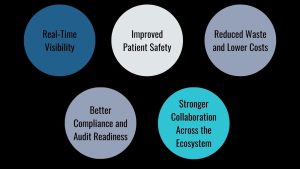
1. Real-Time Visibility
Smart trackers provide a live view of inventory across warehouses, hospitals, and departments. This helps teams:
- Avoid stockouts
- Prevent overstocking
- Identify bottlenecks early
- Balance inventory between locations
As a result, resources are used more efficiently, and emergency shortages become far less common.
2. Improved Patient Safety
By tracking batch numbers, expiration dates, and storage conditions, software reduces the risk of using expired or compromised products. In case of recalls, affected items can be identified and removed immediately.
This traceability is essential for maintaining high safety standards in healthcare.
3. Reduced Waste and Lower Costs
Manual systems often lead to over-ordering “just in case.” Smart systems replace guesswork with data-driven forecasting. They analyze consumption patterns and predict future demand more accurately.
This leads to:
- Lower inventory holding costs
- Less expired stock
- Fewer emergency purchases at premium prices
Over time, this can reduce supply chain costs significantly.
4. Better Compliance and Audit Readiness
Healthcare supply chains are heavily regulated. Smart trackers automatically log transactions, movements, and conditions. This creates a complete digital audit trail.
As a result:
- Compliance reporting becomes easier
- Audits are faster and less disruptive
- Risk of penalties is reduced
5. Stronger Collaboration Across the Ecosystem
Modern supply chain platforms integrate hospitals, suppliers, logistics partners, and manufacturers into one digital flow. This improves coordination and reduces delays.
For example, suppliers can see upcoming demand and prepare shipments earlier. Hospitals can track deliveries in transit. Everyone works from the same data.
Real-World Use Cases
Smart supply chain software is already delivering value in healthcare:
- Hospitals use RFID to track surgical instruments and ensure trays are complete and sterile.
- Pharmacies monitor medication stock and expiration automatically.
- Vaccine distribution networks use IoT sensors to track temperature and prevent spoilage.
- Medical device companies monitor product usage to improve forecasting and support recalls.
These applications show how software directly improves reliability, safety, and efficiency.

How InStandart Supports Smart Healthcare Supply Chains
At InStandart, we help healthcare organizations move from fragmented, manual processes to intelligent, connected systems.
We support this transformation through:
- Custom supply chain and inventory management software
- System integration with ERP, hospital information systems, and supplier platforms
- IoT and sensor data integration
- Data analytics and forecasting tools
- Secure, compliant cloud architectures
Every healthcare organization is different. That’s why we focus on bespoke solutions that match specific workflows, regulations, and operational needs.
Conclusion
The shift from manual logs to smart trackers is more than a technical upgrade. It is a strategic move toward safer, more efficient, and more resilient healthcare systems.
By embracing smart supply chain software, healthcare providers gain control over complexity. They reduce risk. They improve patient outcomes. And they build a foundation for future innovation.
In a sector where reliability saves lives, intelligent supply chains are no longer optional – they are essential.