

Which Mobile Architecture Wins in 2026 – Cross-Platform vs. Native
Introduction Mobile development has never been more strategic. In 2026, mobile apps are no longer just “front ends.” They are business platforms, data collectors, AI interface...
Introduction
Mobile development has never been more strategic. In 2026, mobile apps are no longer just “front ends.” They are business platforms, data collectors, AI interfaces, and operational tools.
As a result, choosing the right mobile architecture – native or cross-platform – is no longer a technical preference. It is a business decision that affects performance, cost, scalability, and time-to-market.
This article provides an explanation about which mobile architecture wins in 2026 – cross-platform vs. native development, and how to choose the right one for your product.
The Two Main Mobile Architecture Approaches
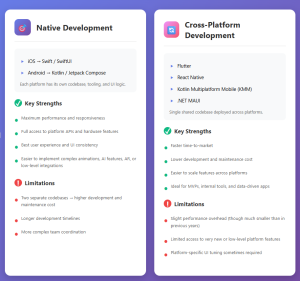
Native Mobile Development
Native apps are built specifically for each platform:
- iOS → Swift / SwiftUI
- Android → Kotlin / Jetpack Compose
Each platform has its own codebase, tooling, and UI logic.
Key strengths:
- Maximum performance and responsiveness
- Full access to platform APIs and hardware features
- Best user experience and UI consistency
- Easier to implement complex animations, AI features, AR, or low-level integrations
Limitations:
- Two separate codebases → higher development and maintenance cost
- Longer development timelines
- More complex team coordination
Cross-Platform Mobile Development
Cross-platform apps use a single shared codebase deployed across platforms. In 2026, the dominant technologies are:
- Flutter
- React Native
- Kotlin Multiplatform Mobile (KMM)
- .NET MAUI
Key strengths:
- Faster time-to-market
- Lower development and maintenance cost
- Easier to scale features across platforms
- Ideal for MVPs, internal tools, and data-driven apps
Limitations:
- Slight performance overhead (though much smaller than in previous years)
- Limited access to very new or low-level platform features
- Platform-specific UI tuning sometimes required
What Changed in 2026
Several trends have reshaped this decision:
1. Cross-Platform Performance Has Improved
Flutter and React Native now compile closer to native performance, and UI rendering is faster and smoother than before. For most business use cases, performance differences are no longer noticeable.
2. AI and Sensor Integration Matter More
Apps increasingly rely on:
- On-device AI models
- Real-time sensor data
- Camera, LiDAR, health sensors, biometrics
These advanced features are still easier to integrate natively, especially when low latency or deep OS integration is required.
3. Development Speed Is a Competitive Advantage
Markets move faster. Products iterate faster. Companies that can test ideas quickly and ship updates weekly often outperform those with perfect but slow releases.
When Cross-Platform Wins in 2026
Cross-platform is the better choice if:
- You need to launch fast across iOS and Android
- Budget and development resources are limited
- Your app is data-driven, form-based, or workflow-oriented
- You are building an MVP or validating a business idea
- You expect frequent UI or feature changes
Typical examples:
- SaaS companion apps
- E-commerce apps
- Healthcare workflow tools
- Logistics and tracking apps
- Internal enterprise systems
Business value: faster ROI, lower cost, easier scaling.

When Native Wins in 2026
Native is the better choice if:
- Performance is business-critical
- The app relies on advanced hardware features (AR, camera, sensors, biometrics)
- You need complex UI animations or custom interactions
- You are building a consumer-grade product with high UX expectations
- You plan deep integration with Apple or Google ecosystems
Typical examples:
- Fintech apps with high security and performance demands
- AR/VR or spatial computing apps
- Gaming, 3D, or media-heavy apps
- Health or fitness apps using advanced sensors
Business value: superior UX, technical flexibility, long-term scalability.

A Practical Decision Framework
Ask these questions before choosing:
| Question | If Yes → |
| Do you need to launch in under 3 months? | Cross-platform |
| Is performance critical to user retention? | Native |
| Do you use advanced device features? | Native |
| Is budget optimization a priority? | Cross-platform |
| Do you need maximum UX polish? | Native |
| Is this an internal or operational app? | Cross-platform |
In practice, the best architecture is often not “either/or” but “both.”
Many companies now use:
- Cross-platform for the main app and business logic
- Native modules for performance-critical or hardware-specific features
This hybrid model delivers:
- Speed + flexibility
- Cost efficiency + technical depth
- Business scalability without sacrificing UX
Conclusion
So, which mobile architecture wins in 2026 – cross-platform vs. native? There is no universal winner. The right choice depends on your business goals, product complexity, performance requirements, and growth strategy.
- Cross-platform wins on speed, cost, and scalability.
- Native wins on performance, deep integrations, and premium UX.
- Hybrid wins when you want the best of both worlds.
The smartest companies are no longer asking “Which is better?”. They are asking: “Which architecture best supports our business strategy?”. At InStandart, we help companies design mobile solutions that match their business goals – not just technical trends. We analyze your product, users, performance needs, and growth plans to recommend and build the optimal mobile architecture.