

Digital Twins in 2026: Where They Deliver Real Results in Industrial Operations
Introduction The concept of digital twins is well understood. The question that matters in 2026 is no longer “what are digital twins?” – it’s “where do...
Introduction
The concept of digital twins is well understood. The question that matters in 2026 is no longer “what are digital twins?” – it’s “where do they deliver measurable ROI, and how fast can we get there?”
For engineering and operations teams in oil and gas, construction, and manufacturing, the answer is increasingly concrete. An AI-driven digital twin of an Air Separation Unit, built from the facility’s 3D model, P&ID, and PFD data, cut operator training time by 50%, reduced onboarding incidents by 80%, and lowered cost per operator by 60%. A CAD/BIM-to-SAP integration system for a midstream gas processing plant improved data synchronization by 85% and reduced data-related reworks by 70%.
These aren’t pilot projects. They’re production deployments delivering measurable business value.
This whitepaper covers the digital twin market in 2026 ($36B and growing), the technology stack that makes industrial digital twins practical, real implementation examples with measured results, and the strategic considerations that determine whether a digital twin initiative succeeds or remains a proof-of-concept.
What Are Digital Twins: A Strategic Overview
At its core, a digital twin is a dynamic digital replica of a physical object, process, or environment that receives real-time data from sensors and systems to simulate, analyze, and optimize performance. Unlike static models or traditional simulations, digital twins maintain continuous synchronization with their real-world counterparts, enabling predictive insights, real-time monitoring, and scenario planning – features essential in today’s data-driven economy.
Key attributes include:
- Real-time data integration from IoT sensors and edge networks
- AI-powered analytics for predictive modeling and optimization
- Scalable cloud/native architectures that enable remote collaboration
- Simulation and forecasting capabilities for complex systems
These capabilities make digital twins exceptional tools for reducing operational risks, improving performance, and unlocking new revenue streams.

In practice, the term “digital twin” covers a spectrum of complexity. At one end – static 3D models connected to a database. At the other – fully autonomous systems with AI-driven behavior simulation, real-time sensor integration, and predictive analytics.
The value – and the implementation challenge – lies in where you need to be on this spectrum. An oil and gas operator training system requires AI-driven real-time behavior simulation. A construction project coordination tool needs live clash detection and version control across disciplines. A smart building requires BIM-to-BMS bridges with energy-aware visualizations. Each is a “digital twin,” but the architecture, data requirements, and development effort are fundamentally different.
This whitepaper focuses on the practical end of the spectrum: digital twins built from engineering data (CAD, BIM, P&ID) for industrial operations – where the ROI is most measurable and the implementation path is best understood.
Market Landscape and Growth Prospects in 2026
The digital twin market continues to expand rapidly, reflecting broad adoption across sectors such as manufacturing, energy, healthcare, smart infrastructure, aerospace, and transportation:
Market Size & Growth
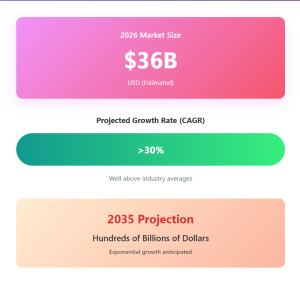
The global digital twin technology market in 2026 is estimated at USD ~36 billion, with projections suggesting exponential growth into the next decade, driven by the integration of AI, advanced analytics, and ubiquitous IoT connectivity.
Some forecasts anticipate the digital twin market reaching hundreds of billions of dollars by 2035, with compound annual growth rates (CAGR) well above industry averages (e.g., >30 % in some scenarios).
Regional & Sector Dynamics
North America leads global adoption thanks to advanced industrial ecosystems and early technology investments.
Asia-Pacific is the fastest-growing region, propelled by smart manufacturing, infrastructure development, and government digitalization programs.
Manufacturing, oil & gas, automotive, and healthcare remain among the top adopters due to tangible ROI on operational efficiency and risk mitigation.
This growth is reinforced by wider trends in Industry 4.0/5.0, where digital twins are key enablers of real-time decision-making and autonomous operations.
Within this broad market, the fastest-growing segment with the most documented ROI is industrial digital twins – systems built from engineering data (CAD/BIM models, P&IDs, simulation outputs) for operational optimization in oil and gas, construction, and manufacturing. This segment benefits from an existing foundation: most industrial facilities already have detailed 3D models and engineering data that can serve as the digital twin’s core, reducing the cold-start problem that plagues digital twin initiatives in other sectors.
Core Business Value of Digital Twins
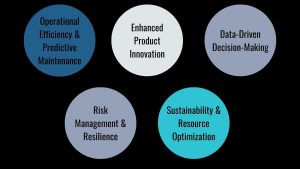
1. Operational Efficiency & Predictive Maintenance
Digital twins transform maintenance strategies from reactive to predictive – anticipating failures before they occur, reducing downtime, and minimizing unplanned maintenance costs. Organizations deploying digital twins report significant improvements in asset performance and lifecycle visibility.
In practice, operational efficiency gains from digital twins are most tangible in data integration – connecting engineering tools with enterprise systems. A custom integration between CAD/BIM platforms and SAP S/4HANA for a midstream gas processing plant improved data synchronization by 85%, reduced data-related reworks by 70%, and improved procurement readiness by 60%. BoM data entry time was compressed from 4 hours to under 15 minutes per update. These efficiency gains compound across every project cycle.
2. Enhanced Product Innovation
Connecting physical and digital realms enables engineers to test scenarios and validate designs virtually. This accelerates time-to-market, reduces prototyping costs, and enhances product quality.
3. Data-Driven Decision-Making
Digital twins fuse real-time operational data with historical performance analytics, empowering business leaders with actionable insights that improve strategic planning and resource allocation.
4. Risk Management & Resilience
Simulating disruptions – whether equipment failure or supply chain shocks – helps organizations evaluate strategies and build resilience. Digital twins become virtual testbeds for contingency planning.
One of the highest-impact applications of digital twins for risk management is operator training simulation. An AI-driven digital twin of an Air Separation Unit – built from the facility’s detailed 3D model, P&ID, and PFD data – enabled safe, repeatable training with interactive SOPs and emergency scenarios. The AI engine simulated real-time ASU behavior based on operator actions and system changes. Results: training time cut by 50%, onboarding incidents reduced by 80%, cost per operator lowered by 60%, and procedure retention improved by 90%.
5. Sustainability & Resource Optimization
By simulating energy use and resource flows, digital twins help organizations monitor emissions and optimize processes to meet sustainability goals and regulatory requirements.
For building operators, digital twins manifest as BIM-to-BMS (Building Management System) bridges with energy-aware visualizations – enabling real-time monitoring of energy consumption, occupancy patterns, and HVAC efficiency. Post-handover asset tracking through digital twins extends the value of BIM investments from construction into the full operational lifecycle of the building.
Technology Trends Shaping Digital Twins in 2026
As digital twin adoption matures, several advanced technologies are reshaping how organizations build, deploy, and scale digital twin ecosystems. These emerging trends are not incremental – they redefine what digital twins can do and how they deliver business value.
AI, Machine Learning & Generative Intelligence
AI and machine learning are no longer optional components of digital twin systems – they are central to improving insight quality and automation.
Predictive Analytics & Anomaly Detection
AI models learn from historical and real-time data to detect degradation patterns or irregular behavior before they affect operations. This enables proactive maintenance that can cut unplanned downtime by up to 50 % or more.
Generative Simulations
Next-generation digital twins can now generate multiple “what-if” scenarios using AI-driven simulation engines. These models allow organizations to test operational changes – from production line configuration to supply chain disruptions – without impacting the real system.
Adaptive Learning
Machine learning models embedded in digital twins continuously refine predictions as new data becomes available. This dynamic learning capability makes digital twins more accurate and resilient over time.
Impact: Smarter decision support, faster root-cause analysis, and automated optimization that extends beyond human capability.
Cloud-Native Platforms & Kubernetes Orchestration
As enterprises scale digital twin deployments, cloud-native design patterns become essential for flexibility, resilience, and developer agility.
Semantic Modeling & Digital Twin Standards
Digital twins are only as useful as their interoperability and shared understanding of data.
Semantic Data Models and Ontologies
Standardized data representations allow twins across different systems and vendors to “speak the same language.” This is especially vital in ecosystems like smart cities or industrial supply chains.
Industry Standards (e.g., ISO, Digital Twin Consortium Models)
Standards organizations are converging on frameworks for common services – such as identity management, lifecycle tracking, and API interchanges. This unlocks cross-platform integration and reduces vendor lock-in.
Impact: Better ecosystem integration, reusable twin components, and accelerated digital twin adoption across partners and suppliers.
Extended Reality (XR) & Immersive Visualization
Digital twins deliver more value when users can interact with them intuitively. Extended reality technologies – including augmented reality (AR) and virtual reality (VR) – elevate twin usability:
AR-Assisted Operations
Field technicians can visualize real-time twin data overlaid on physical machines, enabling faster diagnostics and guided procedures.
Immersive Simulation Environments
VR interfaces allow executives, engineers, and planners to step inside a digital twin and explore scenarios spatially – ideal for facility planning, training, and risk modeling.
Impact: Enhanced human-machine collaboration, faster learning curves, and immersive decision support.
CAD/BIM as the Foundation Layer for Industrial Digital Twins
Most digital twin discussions start with IoT sensors and cloud platforms. For industrial facilities, the more practical starting point is the engineering data that already exists: 3D models in AutoCAD Plant 3D, AVEVA E3D, or Revit; P&IDs in AVEVA Diagrams; simulation data from CAESAR II and Aspen HYSYS; and Bills of Materials in SAP.
This engineering data – already structured, validated, and maintained – forms the geometric and parametric foundation of the digital twin. Sensor data and real-time analytics are the second layer, not the first.
This is important because it changes the implementation path: instead of building a digital twin from scratch, engineering teams can extend their existing CAD/BIM investments into digital twin capabilities – adding real-time data feeds, AI-driven simulation, and operational dashboards on top of data they already have.
How These Trends Translate to Business Value
Together, these technologies transform digital twins into autonomous, adaptable, and collaborative business platforms – not static models. Organizations that leverage these trends can achieve:
✅ Faster insights and decision loops
✅ Operational resilience and agility
✅ Cross-organizational coordination at scale
✅ New revenue models that capitalize on real-time intelligence
In 2026, digital twins are no longer a siloed innovation project – they are an integrated, intelligent backbone of modern digital enterprises.
Challenges and Opportunities in Adopting Digital Twins
While digital twins offer significant strategic advantages, successful adoption requires a clear understanding of both the challenges involved and the opportunities they unlock.
Key Challenges Organizations Face
1. Data Complexity and Integration
Digital twins rely on continuous, high-quality data from multiple sources – IoT sensors, operational systems, ERP, PLM, and external data feeds. Many organizations struggle with fragmented data landscapes, inconsistent formats, and legacy systems that were not designed for real-time integration. Without proper data architecture, the digital twin cannot deliver reliable insights.
The data integration challenge is especially acute in engineering-intensive industries. A typical oil and gas facility has design data in AutoCAD Plant 3D or AVEVA E3D, stress analysis in CAESAR II, process simulation in Aspen HYSYS, procurement data in SAP, and operational data in SCADA systems. These were never designed to share data natively. Custom integration layers – bidirectional sync pipelines with rule-based validators – are required to create a unified data foundation for the digital twin.
2. Security, Privacy, and Compliance Risks
Because digital twins mirror critical physical assets and operations, they become part of the organization’s core infrastructure. This raises concerns around cybersecurity, intellectual property protection, and regulatory compliance – especially in sectors like healthcare, energy, and manufacturing. Strong governance, encryption, and access controls are essential.
3. Organizational Readiness and Skills Gaps
Digital twin initiatives require multidisciplinary expertise across software engineering, data science, domain knowledge, and operational technology. Many companies face internal skills shortages or lack cross-functional collaboration between IT, engineering, and business teams.
The skills gap is particularly sharp at the intersection of CAD/BIM platform expertise, AI/ML development, and enterprise system integration. General-purpose software teams can build dashboards and connect to APIs. But building a digital twin that accurately simulates the behavior of an Air Separation Unit based on 3D model geometry, P&ID logic, and operator actions requires deep domain expertise that combines engineering knowledge with software development – a combination that takes years to develop.
4. ROI Justification and Change Management
Executives often demand clear financial justification before investing in digital twins. If business cases are not well defined, projects risk becoming proof-of-concepts that never scale. Additionally, teams may resist change when new systems alter established workflows.
Strategic Opportunities Digital Twins Create
Despite these challenges, organizations that approach digital twins strategically unlock significant long-term value:
1. Competitive Differentiation
Digital twins enable faster innovation cycles, better product quality, and higher service reliability – all of which strengthen market positioning and customer trust.
2. Operational Resilience and Risk Reduction
By simulating disruptions before they occur, organizations can anticipate failures, test responses, and prevent costly downtime or safety incidents.
3. New Business Models and Revenue Streams
Digital twins enable service-based offerings such as predictive maintenance services, performance-as-a-service models, and outcome-based contracts – opening entirely new revenue channels.
4. Smarter Sustainability and Compliance Strategies
With precise modeling of energy use, emissions, and resource flows, digital twins support ESG goals and regulatory compliance while reducing waste and environmental impact.
5. Better Strategic Decision-Making
Executives gain access to scenario simulations and future projections, allowing them to test strategies digitally before implementing them in the physical world – reducing risk and increasing confidence.
How InStandart Builds Digital Twins – With Measured Results
Our approach to digital twins starts from engineering data, not from platforms. We build digital twins on the foundation of CAD/BIM models, P&IDs, and simulation data that your engineering team has already created – extending their value into operations, training, and real-time monitoring.
What We’ve Built
AI-Driven Operating Simulator for an Air Separation Unit. A Unity-based digital twin built from the facility’s detailed 3D model, P&ID, and PFD data. The AI engine simulates real-time ASU behavior based on operator actions and system changes. Interactive SOPs and emergency scenarios enable safe, repeatable training. Performance tracking measures trainee competence objectively. Results: training time cut by 50%, cost per operator reduced by 60%, onboarding incidents decreased by 80%, retention of procedures improved by 90%.
CAD/BIM-to-SAP Integration for a Midstream Gas Processing Plant. A custom integration tool that automatically syncs 3D models, P&ID data, and Bills of Materials with SAP S/4HANA – the data foundation layer that connects engineering design to enterprise operations. Results: data synchronization improved by 85%, data-related reworks dropped by 70%, procurement readiness improved by 60%.
3D Model Review Tool with Clash Detection and Version Control. A multi-discipline coordination system that serves as a collaborative digital twin of the design process itself – tracking model state, clashes, and resolutions across piping, structural, electrical, and instrumentation teams. Results: review time reduced by 50%, manual errors cut by 80%, cross-team coordination improved by 90%.
Our Technology Stack
We build digital twins using Unity 3D and TensorFlow for visualization and AI simulation, .NET/C# and Python for integration logic, MQTT and OPC UA for real-time IoT connectivity, and native CAD APIs (AutoCAD API, Plant 3D SDK, AVEVA PML, Revit API) for direct engineering data access. Enterprise integration spans SAP S/4HANA, Oracle ERP, Teamcenter, and operational systems like SCADA.
Our approach: BIM and Digital Twin Development covers the full spectrum from conceptual models to operational digital twins.
Conclusion: From Market Trends to Production Deployment
The digital twin market is growing at 30%+ CAGR. The technology works. The ROI is documented – from 50% reductions in training time to 85% improvements in data synchronization to 80% decreases in onboarding incidents.
The practical question for every engineering and operations leader is the same: what’s the fastest path from “interesting technology” to “working in our specific environment, with our specific tools and data”?
For organizations that already have detailed 3D models, P&IDs, and engineering data in AutoCAD Plant 3D, AVEVA E3D, Revit, or Smart 3D – that data is the foundation of your digital twin. It doesn’t need to be rebuilt. It needs to be connected, enriched with real-time data, and made operational.
If your team is exploring digital twins for operator training, design coordination, asset management, or engineering-to-operations data integration – explore our CAD services.