

How Engineering Projects Actually Get Delivered – And Where Automation Earns Its Place
Most “project delivery process” articles describe a five-box diagram that could belong to any agency. Ours won’t – because engineering projects don’t f...
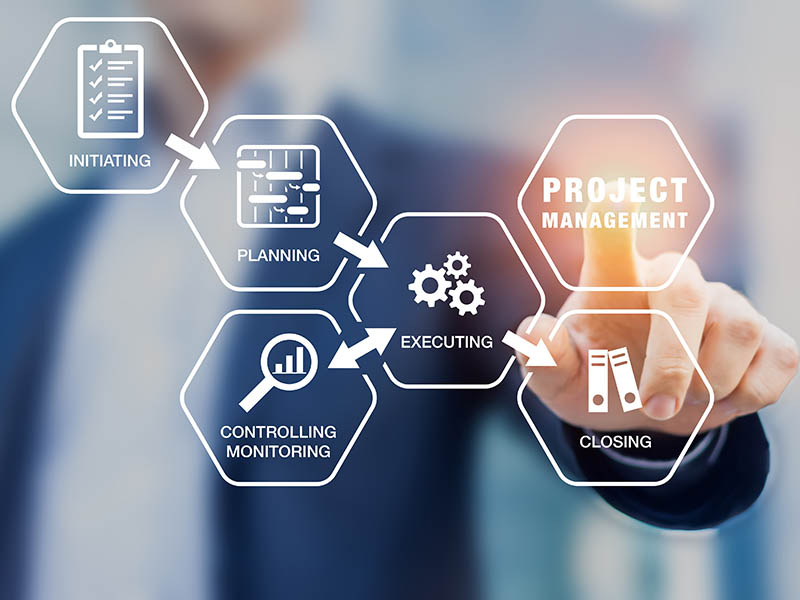
Most “project delivery process” articles describe a five-box diagram that could belong to any agency. Ours won’t – because engineering projects don’t fail inside the boxes. They fail in the handoffs between them: a formwork layout recalculated from scratch, a Bill of Materials retyped into SAP by hand, a clash caught on site instead of in the model. That’s where cost and schedule actually leak.
Below is the eight-stage process we run for CAD/BIM and industrial engineering projects – and, more usefully, the specific points where automation stops the leak. One principle first: InStandart doesn’t replace your CAD platform or your manufacturer’s software. We build the automation layer on top of it, for the geometry, the legacy integrations, and the domain logic that off-the-shelf tools and AI code generation can’t handle.
Stage 1 – Pre-Project / Conceptual
Before anything gets modelled, we define the actual engineering problem: constraints, applicable standards, feasibility. The most valuable output here isn’t a plan – it’s identifying which step in your current workflow is bleeding time. It’s almost always the same profile: manual, repetitive, and dependent on one senior engineer’s experience.
Stage 2 – FEED (Front-End Engineering Design)
Front-end design sets the data model everything downstream inherits – naming conventions, classifications, structure. Get this wrong and it surfaces later as procurement chaos. This is where we design how data will flow between your CAD environment and your enterprise systems, not just what gets drawn.
Stage 3 – Detail Design
This is where manual repetition dominates, and where automation pays for itself fastest. Formwork is the clearest example: calculating panel layouts and optimising reuse across pour stages can take days per structure, and the result depends on who ran it. Our formwork calculation automation (POSforAFS/FormCalc) cut that cost by 70% and compressed turnaround from weeks to hours – with output quality determined by the algorithm, not individual expertise.
Stage 4 – Simulation & Validation
Validation is where late errors are cheapest to fix – if you catch them here rather than on site. Automated clash detection, model review, and compliance checks (naming, LOD, RC volume control) turn validation from a manual reconstruction effort into a continuous check. On one 3D model-review engagement, real-time cross-discipline coordination and enforced resolution deadlines cut late-stage design changes and the rework they cause.
Stage 5 – Procurement & Documentation
This is the handoff that quietly kills schedules – engineering data manually re-entered into ERP. On a midstream gas processing plant, AutoCAD Plant 3D and SAP S/4HANA didn’t talk to each other. We built a bi-directional integration that dropped BoM error rates from 15% to under 2%, cut engineering-to-procurement handover from 6+ weeks to one, and moved asset registration from ~10 days to same-day. BoM data entry went from ~4 hours to under 15 minutes per package.
Stage 6 – Construction & Installation
Field reality diverges from the model. The goal here is a single source of truth so that discrepancies get resolved before they become rework – shared visibility across design offices and the construction site, rather than reconciliation in coordination meetings.
Stage 7 – Commissioning & Handover
Handover fails when it’s paper- and spreadsheet-based. We make it digital and traceable: every data transfer logged with timestamps, source records, and validation results, so audit and regulatory preparation is a query rather than a manual reconstruction.
Stage 8 – Operations, Maintenance & Training
The project doesn’t end at handover. Asset data flows into operations, and operators need to be ready before day one. Simulation-driven operator training (SiteSim) built on the plant’s own model lets teams practise procedures against realistic scenarios instead of live equipment.
The Pattern Worth Noticing
Read the eight stages again and the through-line is clear: automation earns its place at the seams – the calculation redone every time, the data retyped between systems, the clash found too late. Off-the-shelf CAD and manufacturer software handle the stage; they rarely handle the handoff. That gap is exactly what we build for.
Share this post:
Where's your bottleneck?
If one stage in your own process is the reliable bottleneck – the recalculation, the retyped BoM, the on-site clash – that's usually the one worth automating first. If you'd like a second opinion on which one, we're happy to look at it.