

Operator Training Simulator for an Air Separation Unit Built from Detailed Design
A gas separation facility needed to train operators on a complex air separation unit (ASU) before commissioning. Live equipment training was too risky and too expensive — shut...
A gas separation facility needed to train operators on a complex air separation unit (ASU) before commissioning. Live equipment training was too risky and too expensive — shutting down or isolating plant sections for onboarding disrupted productivity, and inexperienced operators made procedural errors that created genuine safety exposure.
InStandart built a custom Unity-based operator training simulator using the client’s detailed 3D model, P&IDs, and PFDs. The result was a realistic, interactive virtual plant where operators could learn standard procedures, practice emergency responses, and be assessed — without any risk to personnel or equipment.
Project Summary
| Industry: | Industrial Gas — Air Separation |
| Facility: | Air Separation Unit (ASU) — cryogenic process plant |
| Source Data: | Client 3D model, P&IDs, Process Flow Diagrams |
| Project Scope: | Custom operator training simulator with AI-driven process model, scenario engine, and performance tracking |
| Core Technologies: | Unity, AI Process Model, 3D Plant Environment, Analytics Engine |
The Problem: Training Operators on Complex Process Equipment Without Live Risk
Air separation units operate under extreme cryogenic conditions, handling liquid oxygen, nitrogen, and argon at temperatures below −170°C. Training operators on live ASU equipment is inherently hazardous — and expensive. The client faced a set of compounding challenges that conventional training approaches couldn’t resolve:
- High Onboarding Risk on Live Equipment. Inexperienced operators had difficulty grasping the dynamic behavior of ASU systems during live training — the interdependencies between compressors, heat exchangers, distillation columns, and control systems are not intuitive. Procedural errors during onboarding created genuine safety exposure, including the risk of pressure surges, oxygen enrichment events, and cryogenic spills.
- Expensive Training Downtime. Preparing the plant for operator training required temporarily shutting down or isolating equipment sections. This disrupted production schedules, increased operating costs, and created a structural incentive to minimize training time — which directly conflicted with the depth of preparation the plant’s complexity demanded.
- Inconsistent Knowledge Transfer. Traditional training relied on classroom instruction, static P&ID diagrams, and shadowing experienced operators. None of these methods could convey the dynamic behavior of the plant under varying load conditions or abnormal events. Retention was low (~60% of operating procedures recalled post-training) and knowledge gaps only surfaced during real operations.
- No Emergency Scenario Practice. Operators had no structured opportunity to experience and respond to rare but critical failure modes — valve failures, oxygen purity drops, power loss, cryogenic leaks — before encountering them on a live plant. These scenarios cannot be safely simulated on real equipment, which meant operators were effectively unprepared for the events that mattered most.
The Solution: Unity-Based ASU Operator Training Simulator
InStandart developed a customized operator training simulator built directly from the client’s engineering documentation — the detailed 3D model, P&IDs, and process flow diagrams. The simulator replicates real plant conditions with sufficient fidelity to train operators on both routine procedures and abnormal event response. It has six core components:
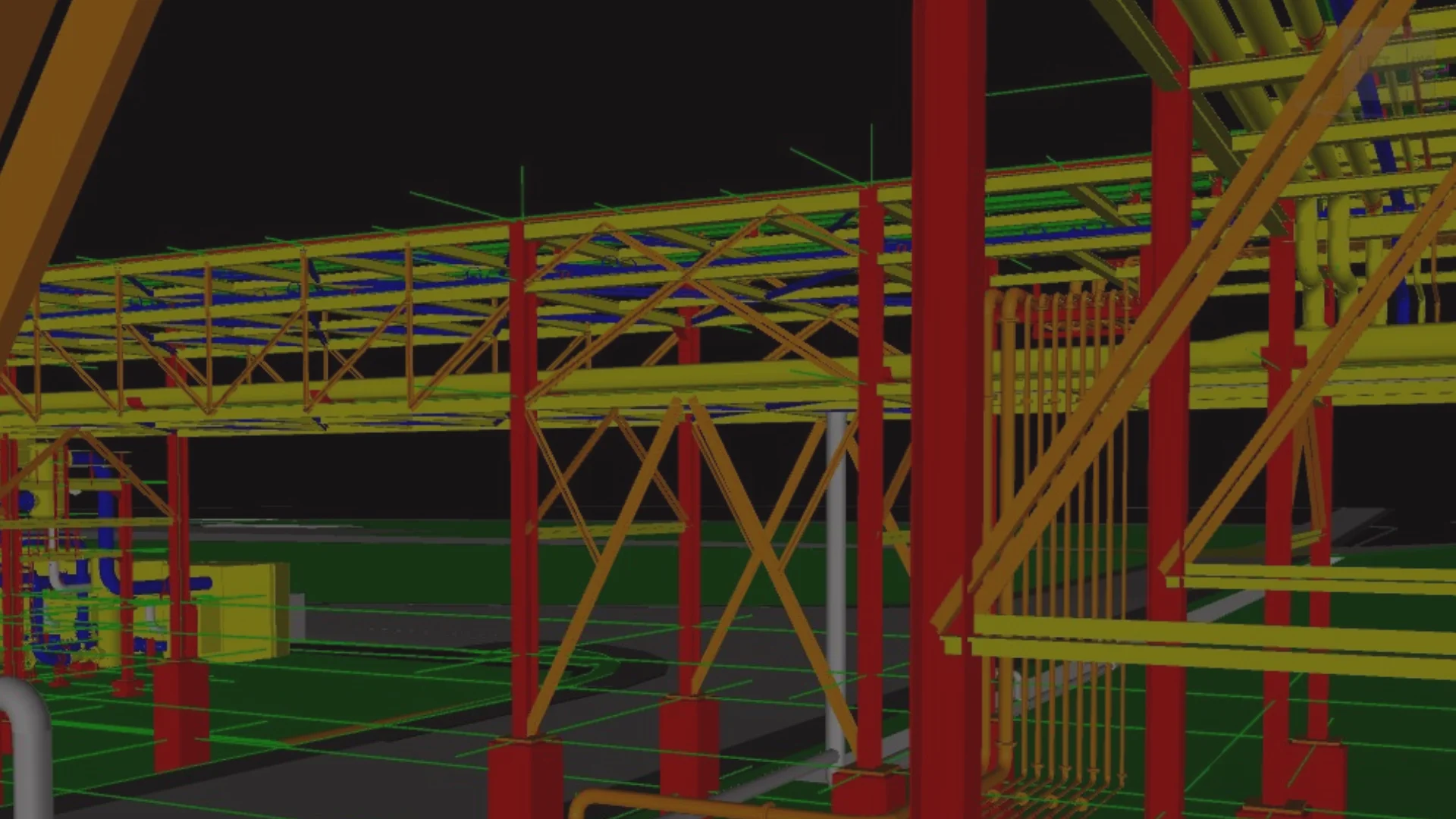
- 3D Plant Environment. Built in Unity using the client’s detailed 3D model, the simulator creates a navigable virtual replica of the actual ASU layout — equipment positions, pipe routing, instrument locations, and access routes match the physical plant. Operators learn spatial orientation and equipment location before they set foot on the real facility, reducing the cognitive load of first-day live plant exposure.
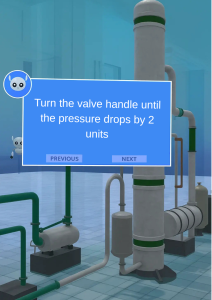
- AI-Driven Process Simulation Model. A specially trained AI model simulates the thermodynamic and process behavior of the ASU in real time, responding dynamically to both operator actions and internal system changes. When a trainee adjusts a valve position, changes a setpoint, or triggers a shutdown sequence, the process model calculates and displays realistic downstream effects — pressure changes, temperature shifts, flow variations — exactly as they would occur on the real plant.
- Interactive Training Modes. Operators can practice across three structured models: Standard operating procedures (SOPs) — guided walkthroughs with step validation; Emergency shutdown sequences — timed response drills with decision branching; Fault diagnosis and response — identifying root causes and executing corrective actions
- Scenario-Based Emergency Training. Customizable fault scenarios — oxygen purity drop, power loss, compressor surge, cryogenic leak — can be triggered at any point in a training session. Each scenario includes step-by-step assessment and real-time feedback, so operators understand not just what happened but why their response was correct or where it deviated from procedure. These are precisely the scenarios that cannot be safely practiced on live equipment.
- Operator Interface Replica. Intuitive controls and instrument dashboards match the actual HMI layout operators will encounter on the real plant. Trainees interact with the same valve controls, flow indicators, pressure gauges, and alarm panels they will use in production — so muscle memory and interface familiarity transfer directly from simulator to plant.
- Performance Tracking & Analytics. A built-in analytics engine logs every trainee action — correct steps, procedural deviations, response times, and error patterns — producing a complete digital training record for each operator. Training managers can review individual performance, identify knowledge gaps across teams, and generate audit-ready documentation of training completion and competency assessment.
Results
Measured against the same training workflows before the simulator was deployed:
| Training KPI | Before | After |
|---|---|---|
| Operator onboarding duration | 4–6 months | 2–3 months |
| Incidents during onboarding | Moderate frequency | Reduced by 80% |
| Training cost per operator | High (live equipment dependency) | Reduced by 60% |
| Procedure retention (post-training) | ~60% | >90% |
| Emergency response preparedness | Low (no safe practice opportunity) | Improved by 70% |
Additional operational improvements:
- Increased operator confidence and faster response times under both normal and abnormal plant conditions
- Remote training capability eliminates the need for trainees to travel to site before being ready for live plant exposure
- Repeatable training with zero risk to personnel or equipment — scenarios can be run as many times as needed without any operational consequence
- Improved HSE compliance and audit readiness through digital training logs with timestamps, action records, and competency scores for every operator
Why This Problem Is Hard (and Why Generic Simulation Tools Don’t Solve It)
Operator training simulators exist as a product category. So why did this project require custom development rather than an off-the-shelf training platform?
- Plant-Specific Process Fidelity. Generic simulators use generalized process models. An ASU has a specific thermodynamic configuration — column design, heat exchanger sizing, compression ratios, product purity setpoints — that determines how the plant actually behaves. A simulator that doesn’t reflect these specifics will train operators on responses that don’t match real plant behavior, creating false confidence rather than genuine preparedness.
- 3D Model as the Source of Truth. Building the simulator environment from the client’s own detailed 3D model ensures that spatial layout, equipment positions, and access routes are accurate to the actual facility. Off-the-shelf simulators use generic plant representations that operators then have to mentally re-map to the real plant — an additional cognitive step that slows learning and degrades transfer.
- P&ID-Level Instrument Integration. Operators need to interact with the same instruments and control logic they will use on the real plant. This requires mapping P&ID instrumentation — every transmitter, controller, and valve — into the simulator’s interactive interface. A generic training tool cannot replicate plant-specific control philosophy without custom integration work.
- Real-Time Dynamic Response. ASU processes involve slow thermal dynamics, cascading process interactions, and non-linear responses to operator actions. Simulating this in real time — so that the training experience feels like the real plant, not a simplified approximation — requires a purpose-built AI process model that reflects the actual unit’s engineering characteristics, not a library model from a different facility type.
Applicability: Where This Approach Works
The simulator architecture developed for this ASU project applies wherever complex process equipment needs to be operated safely — and where the cost or risk of live training is prohibitive:
- Oil & Gas Processing. Operator training simulators for gas processing plants, LNG terminals, and refineries — where process complexity, hazardous materials, and high-consequence failure modes make live training risky and expensive.
- Chemical & Petrochemical. Plants handling reactive, toxic, or flammable materials where procedural errors during onboarding carry significant safety and environmental consequences that cannot be accepted on live equipment.
- Power Generation. Thermal, combined-cycle, and nuclear power facilities where control room operators need to practice abnormal event response — load shedding, emergency shutdowns, grid disturbances — in a zero-risk environment.
- Industrial Gas Production. Air separation, hydrogen production, and gas purification units where cryogenic or high-pressure process conditions make onboarding on live equipment inherently hazardous.
- Mining & Minerals Processing. Ore processing, smelting, and flotation plants where equipment scale and process interactions make it impractical to provide every new operator with adequate hands-on exposure before independent operation.